

Recently, a friend sent me a video where a young man, using clips of Michael Heiser presenting his unique view on Armageddon, claimed that we have all been mistaught on Armageddon. My friend was curious to know what I thought about the video. Here is my response. In the first part, I briefly summarize Heiser’s view of Armageddon as it was presented in the video. In the second part, I respond with ten brief bullet points.
Michael Heiser’s view.
1. Confusion on the Battle of Armageddon. There is no battle of Armageddon. For one thing, there is no battle that is limited to the Valley of Megiddo. For another thing, Armageddon will not take place at the Valley of Megiddo but at Jerusalem.
2. The real meaning of the word Armageddon. Armageddon is comprised of two words: har (hill) and m-g-d. The word m-g-d is usually understood as a reference to Megiddo, but this can’t be right because there is no hill in the valley known as Megiddo. It is better to understand it as Mo’ed, which is an appointed time, place, or feast. So we should be looking for a hill of appointment or an appointed hill.
3.The real location of Armageddon. The most likely candidate for this hill of appointment is Jerusalem. This fits the big picture better because other passages have Jerusalem surrounded by armies on the final day.
Here are my thoughts in response.
1. I love Michael Heiser’s teaching in general on the spiritual realm. I find it insightful. BUT, I find myself skeptical on several points, including his technical insights on the supposed actual meaning of various Hebrew and Syriac words.
2. He is correct that Armageddon is a transliteration. He is correct that it is generally understood to be a transliteration of Har Megiddon (Hill or Mount of Megiddo).
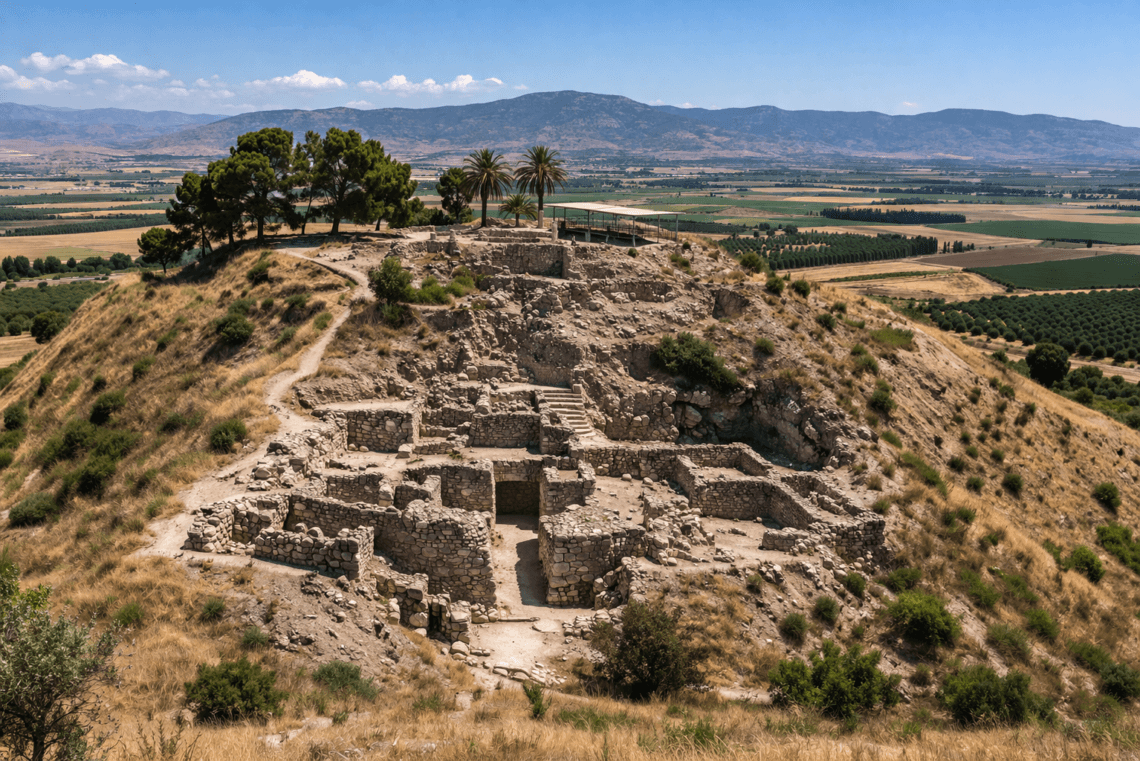
3. He correctly points out that there is no Mt. Megiddo. There is only the low, man-made hill (Tel) of Megiddo, which is the site of the ancient city of Megiddo on the SW edge of the Jezreel Valley.
4. But, he is mistaken when he uses this lack of a hill in the Megiddo region as proof that we should be looking for Armageddon elsewhere—somewhere where there is a hill—like Mt. Zion in Jerusalem.
5. He has overlooked the fact that Armageddon is not only the English transliteration of הַר מְגִדּוֹ (har Megiddon), which means “hill of Megiddo,” but it is also the transliteration of עָר מְגִדּוֹ (‘ar Megiddon), which means “city/town of Megiddo.” When the Hebrew letter ayin ע appears at the beginning of a word, it is generally transliterated by the rough breather or ignored.
6. The Brown, Driver, and Briggs lexicon informs us that עָר (‘ar) = עִיר (‘ir), “city.” In other words, the former is a less common spelling variation of the common word for city.
7. For instance, in Numbers 21:28 we read about עָר מוֹאָך ‘Ar Moab which means City Moab or, as we would say in English, Moab City. Following this biblically attested pattern, Ar Megiddon would be Megiddo City. Scholars suggest that where ‘Ar appears without qualification, it should be understood along the lines of Citadel, which is a fortified city.
8. Once you understand that Ar as “city” makes more sense contextually and grammatically than Ar as “hill,” then we can stick with the traditional understanding of Megiddo, and we don’t need to resort to speculations that Megiddo should be Mo’ed, and that the hill of Mo’ed is Mt. Zion in Jerusalem.
9. Clarifications on Armageddon. It should be understood that when we talk about the battle of Armageddon, we are not saying that the battle is limited to the Valley of Megiddo. Megiddo is merely the staging grounds and headquarters encampment for a battle that sees Jerusalem surrounded by her enemies. Armageddon is where the antichrist gathers the kings of the earth and his chief generals. Because of this headquarters and staging focus, Armageddon has become the theological term for the entire battle which extends far beyond the region of Megiddo, completely surrounding Jerusalem. There will be a great crushing in the Valley of Megiddo in this awful day, but it won’t be the only crushing in that day.
10. As is almost always the case, we are better off to embrace the less exotic (more mundane) technical explanation, long- and well-established, than a new-fangled technical explanation which involves unestablished assumptions and leaps of speculation.
May these observations prove helpful, both for the meaning and location of Armageddon, and for the broader point, which is hesitancy when it comes to cool new theories. While cool theories do occasionally prove to be true, most of the time they run roughshod over established facts and a consistent application of the historical-grammatical hermeneutic.
Eyes Wide Open, Brain Engaged, Heart on Fire
Lee W. Brainard


No Comments