
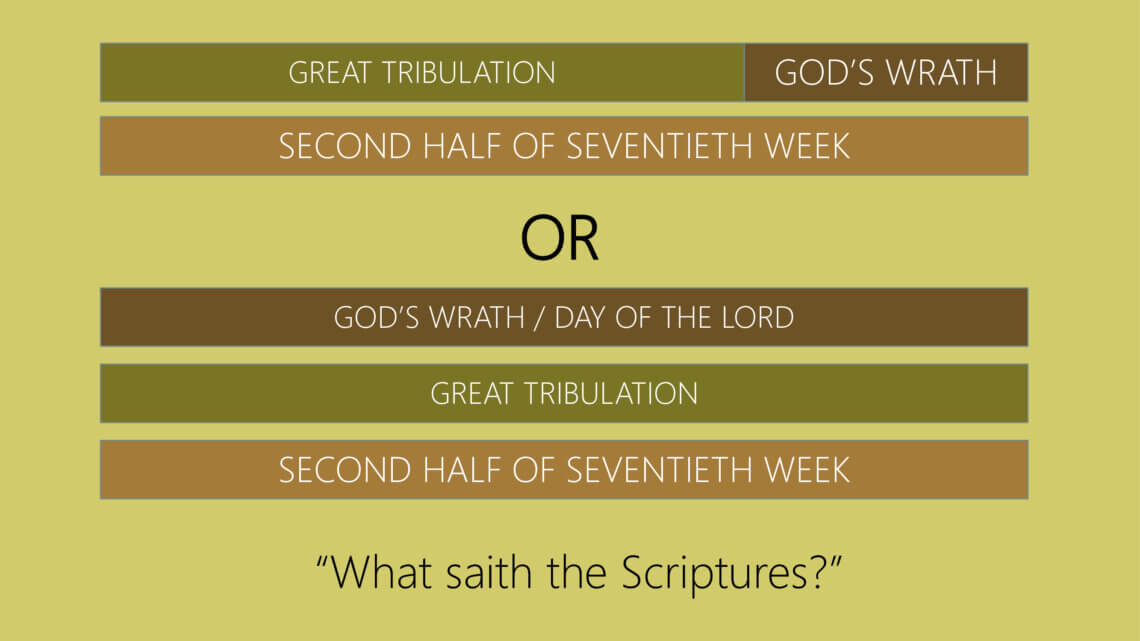

Prewrath’s Back-to-Back Teaching on Tribulation and Wrath
The prewrath advocates claim that God’s wrath (the Day of the LORD) and the Great Tribulation are two distinct periods. So distinct, in fact, that they run back to back. The wrath of God cannot start until the Great Tribulation has ended. The Great Tribulation, according to prewrath teaching, is Satan’s wrath. It starts at the mid point of Daniel’s 70th Week and lasts for an unknown length of time until it is brought to an abrupt halt sometime in the middle of the second half of the 70th Week when Jesus unexpectedly comes with all His power and glory to rapture the church saints to Himself. At the same time, Jesus resurrects and raptures (yes, raptures) the Old Testament saints to heaven. Then, and only then, can God’s wrath (the Day of the LORD) commence, which could potentially last a few years. This is indeed what the prewrath advocates teach, and you can verify this on their websites and in their books.
The Bible’s Use of Wrath and Tribulation
But Scripture does not support such a fine distinction between the Tribulation and God’s wrath (the Day of the LORD).
Sometimes the apparently softer word tribulation is used to describe the very bitter end of the 70th Week, or what prewrathers would call God’s wrath, while words like wrath can be used to describe the Tribulation period in general, thereby making these terms virtually interchangeable.
In the following examples, we will examine the Hebrew words used in Old Testament tribulation and wrath passages, the Greek words used to translate them in the Septuagint (the Greek translation of the OT, often written as LXX), and the New Testament usage of these same Greek words. The LXX is a bridge between the Hebrew OT and the Greek NT, transporting OT usage and meaning into the NT.
1. Zephaniah 1:15 calls the Day of the LORD tribulation.
When describing “the great day of the LORD” (v. 14), which the prewrathers would call “God’s wrath,” Zephaniah calls it “a day of trouble and distress.” The Hebrew word for trouble is צָרָה tzara (trouble, affliction). This word is translated in the LXX as thlipsis, the exact same word translated tribulation in all main New Testament tribulation passages, such as Matthew 24, Mark 13, and others. This makes the tribulation and the Day of the LORD interchangeable.
2. Habakkuk 3:16 calls the Day of the LORD tribulation.
In a passage about the Day of the LORD, Habakkuk begs the LORD to be merciful during wrath (v. 2) and talks about the light of His glory covering the skies (vs. 3-4) and His trampling the nations in anger (v. 12) as He goes forth to save His people Israel (v. 13). These are clearly talking about the last stages of Daniel’s 70th Week. Habakkuk experienced an extreme physical reaction at the thought (v. 16). He wishes then “that [he] might rest in the day of trouble,” clearly referring to that same day, making “day of trouble” a description of that terrifying Day of the LORD. Yet here too, the Hebrew uses the general word tzara (trouble) or Yom Tzara (day of trouble). This, again, is translated in the LXX by thlipsis, the same word used for tribulation in the English New Testament translations, making “the Tribulation” and “God’s wrath” interchangeable.
3. Jeremiah 30:7, tribulation lasts until the end of the 70th Week.
From this important Tribulation passage we learn a few things.
One, a dreadful day is coming, causing similar physical reactions to those of Habakkuk.
Two, that day is called “the time of Jacob’s trouble”, again using the Hebrew word tzara (trouble), translated regularly in the LXX by thlipsis (tribulation), the same word translated tribulation in all major New Testament tribulation passages. Though the LXX uses stenos (difficulty, trouble) here, both Aquila and Symmachus use thlipsis (trouble, tribulation). This is Israel’s tribulation, which starts at least at the second half of the 70th Week, if not earlier. This tribulation ends at the second coming of Israel’s King when he destroys their enemies (Jer. 30:8,9).
Three, it is described as a day so “great, so that none is like it.” This is very significant. According to prewrath, the worst part of the seventieth week is actually a separate day called the Day of the LORD, which can only start once the Tribulation is over. Yet, the description of the Tribulation according to Jeremiah is that a worse day than the Tribulation is nowhere to be found. This corresponds with Daniel’s description in 12:1, that “there shall be a time of trouble (tzara), such as never was since there was a nation, even to that time;” and with the Lord’s description, that “there will be great tribulation, such as has not been since the beginning of the world until this time, no, nor ever shall be” (Matt. 24:21). You can go from bad to worse, but you can’t go from “worst ever” to “even worse.”
Four, Jeremiah says it is “the time of Jacob’s trouble, but he shall be saved out of it” (7), i.e. he is saved out of the Tribulation. That means that Israel is brought through the Tribulation until the end and then saved. The same is implied from Daniel 12:1-2, where the time of trouble lasts until the time of national deliverance and resurrection. Here again, Israel is saved out of the Tribulation, not out of a separate phase that comes after it. This means that the Tribulation lasts until the end of the 70th Week. If anyone would think the Day of the LORD is a phase occurring at the end of the 70th Week, then they must place that day within what is called the Tribulation, not separately and subsequent to it.
Five, to further strengthen the point above, we conclude from vv. 8-9 that Israel is freed from the yoke of her oppressors and worships God alone on “that day,” i.e. during “the time of Jacob’s trouble.” This glorious deliverance, of course, only happens at the very end of the 70th Week, showing once again that the Tribulation continues until the end of the 70th Week.
4. The wrath spoken of in Isaiah 26 spans the entire second half.
Isaiah 26:20-21: “Come, my people, enter your chambers, and shut your doors behind you; hide yourself, as it were, for a little moment, until the indignation is past. For behold, the Lord comes out of His place to punish the inhabitants of the earth for their iniquity. …”
Notice the following observations:
One, the ending verses of Isaiah 26 speak about Israel’s place of hiding during the Tribulation. God’s protection and nourishment of Israel, His vine, during this time is expressed a few verses later: “… ‘A vineyard of red wine! I, the Lord, keep it, I water it every moment; lest any hurt it, I keep it night and day” (27:2-3). The place of hiding is the same as where “the woman fled into the wilderness, where she has a place prepared by God” and “where she is nourished for a time and times and half a time” (Rev. 12:6, 14). It is where Israel flees to when the Abomination of Desolation is set up, and concerning which place she is told “do not go out” (Matt. 24:26) until Messiah returns (Matt. 24:15-16, 26). Israel’s flight occurs at the midpoint of the 70th Week.
Two, Israel is told to wait in hiding “until the indignation is past.” Indignation in the Hebrew is זָעַם (zaʻam), meaning anger, rage, fury, wrath. The Greek word used in the LXX is orgē, the main word used for wrath in Old Testament passages like Isaiah 13 and all main New Testament passages dealing with the wrath, like 1 Thess. 5:9 (“not destined us for wrath”), Rev. 6:17 (“the wrath of the Lamb”), etc.
Three, the fact that the entire second half is God’s wrath is proved by v. 21. The reason Israel is going into hiding at the midpoint of the 70th Week is because Jehovah Himself has come out of His place to visit the iniquities of the inhabitants of the earth, practically equating the Great Tribulation with God’s wrath.
Four, this natural understanding of the text is shared by the Septuagint translators who translated zaʻam (v. 20) by orgē Kuriou (the wrath of the Lord) and by Brenton’s translation of the Septuagint (the anger of the Lord).
5. Luke 21 Calls the Second Half “Vengeance” and “Wrath.”
Luke 21:21-23: “Then let those who are in Judea flee to the mountains, let those who are in the midst of her depart, and let not those who are in the country enter her. 22 For these are the days of vengeance, that all things which are written may be fulfilled. 23 But woe to those who are pregnant and to those who are nursing babies in those days! For there will be great distress in the land and wrath upon this people.”
Notice the following observations:
One, the flight to the mountains, the pregnant women, etc., correspond to the midpoint of the 70th Week as found in Matthew 24, so it’s definitely speaking of the Tribulation.
Two, Luke uses the word orgē (wrath) in v. 23 to describe the Tribulation. He does not mention two different types of wrath — “Satan’s wrath” and “God’s wrath.” That distinction is read into the passage by splitting the wrath mentioned here into two phases or types. Indeed, the saying “wrath upon this people” suggests that it’s God’s wrath under consideration. The phrase “this people” conveys God’s displeasure with his people that is so frequently mentioned in the pages of Scripture —“this people draw near me with their lips,” “with men of other tongues… I will speak to this people,” “the heart of this people has grown dull,” etc. (Is. 29:13, 1 Cor. 14:21, Acts 28:26-27).
Three, likewise, using the phrase “the days of vengeance” to describe the Tribulation (the time of Jacob’s trouble) implies that it is coming from God, since revenge for sin and unbelief is ascribed to God, not to Satan. Compare “the day of vengeance of our God” (Is. 61:2, 34:8, 35:4). God’s revenge is against Israel’s rejection of the Messiah.
The above passages show clearly that the Bible uses the terms wrath (or the Day of the LORD) and tribulation interchangeably.
There is no room for the distinction between them that the prewrath camp insists upon. They are not mutually exclusive. They share much semantic overlap in language in general and in biblical revelation in particular. Therefore there is no place for prewrath’s teaching that tribulation and wrath are back to back.
What, then, does the Bible mean when it says “except those days should be shortened” (Matthew 21:22)?
The prewrath advocates insist that when Jesus said “except those days should be shortened,” he meant that the Great Tribulation would be shortened to less than 3½ years. The remainder of the second half of the 70th week is a separate and distinct phase – the wrath of God. But this handling is contrary to Scripture. The days of the tribulation are not made shorter than 3½ years. In multiple places we read that the severe persecution of the Tribulation will continue for “a time and times and half a time” (Dan. 7:25, Rev. 12:4), for “forty two months” (Rev. 11:2, 13:5), and for “one thousand two hundred and sixty days” (Rev. 12:6) — in other words, exactly 3½ years. This is also the length we see in Daniel 12 where the time of trouble (v. 1), even the scattering of the holy people (v. 7), shall continue for a time, times, and a half a time (v. 7). And if the “shortened” great tribulation is 3½ years long, then the word “shortened” can’t be exploited to teach the back-to-back view of tribulation and wrath.
So what does the phrase “except those days should be shortened” mean? It means that “those days” will be shortened to (limited to, restricted to) 3½ years. They will be brought to an end at their appointed end and will not be allowed to continue indefinitely. The interpretation that “those days” will be shortened to less than 3½ years renders the many specific references to their exact duration meaningless.
Conclusion
The distinction between the Tribulation and the Wrath (or Day of the LORD) is purely artificial.
Making a no-overlap distinction between tribulation and wrath (the day of the Lord) might seem plausible to the undiscerning eye at first glance, but an examination of the relevant passages shows clearly that this distinction is an artificial distinction that is, sadly, forced upon the Bible and upon the minds of many, tricking them into falling for the prewrath-rapture position. The propagation of the idea that the tribulation and the wrath of God run back to back has done a lot of damage in the world of prophecy, causing confusion for many who haven’t properly looked into the matter. It will take a lot of time and effort on the part of pretribulationists to undo the damage done by this false presupposition.
The prewrath rapture position should be rejected.
The prewrath rapture position has received more than a fair hearing since its inception. Its arguments have been digested, examined and debunked. The position should be rejected as inadequate. If any of you have for some reason felt disillusioned with the pretribulation position and gone astray after the prewrath view, I solemnly call you back. The pretribulation rapture is vastly more theologically robust and biblically consistent than the prewrath theory. Studying the prewrath system has only served to strengthen my pretribulational convictions.
Michael Nissim
(edited by Lee W. Brainard)

2 Comments
Tom Brosky
February 26, 2024 at 11:07 pmMichael (and Lee),
Thank you for writing an article that presents plenty of biblical evidence to confirm what I have believed for years about the wrath of God being concurrent with tribulation during Daniel’s 70th week! The only point I disagree with is your fifth point about Luke 21:21-23 because Luke 21:20-24 is about the destruction of Jerusalem that occurred in 70 AD, NOT about the last 3.5 years of Daniel’s 70th week. Proof of this is in verse 24.
Tom
Lee Brainard
April 11, 2024 at 5:54 pmThanks, Michael, for this article.