

Introduction
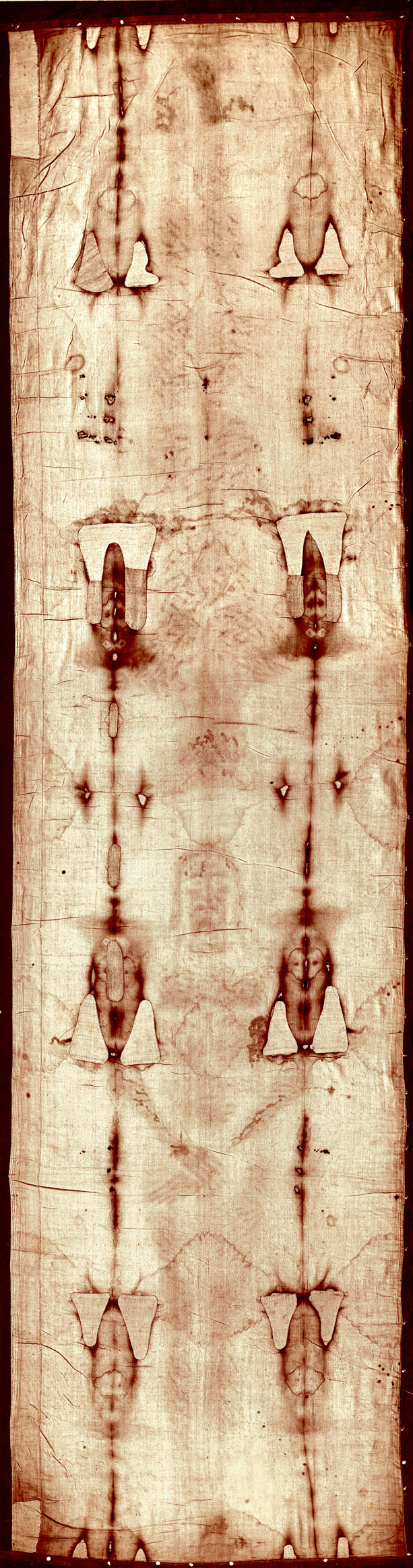
The Shroud of Turin, a length of linen cloth about three feet, eight inches wide and fourteen feet, four inches long,[1] is probably the most famous relic in the Catholic Church. It bears a faint image of a man with wounds that resemble those depicted in the historical account of Christ’s crucifixion and on this account is prized by many as the actual burial cloth of Jesus. It has been an object of veneration for centuries. Since 1578 it has been housed in the Cathedral of Turin. Its advocates claim that its history is documented all the way back to 1356, though parts of this trail appear to be dubious to some investigators.
The official results of the STURP research—conducted by a team of scientists, most of whom were unconvinced that the Shroud was the actual burial shroud of Christ—came to the startling conclusion, “We can conclude for now that the Shroud image is that of a real human form of a scourged, crucified man. It is not the product of an artist.”[2] The image has been determined to be a photo-negative, and it comes into much clearer focus when the negative is reversed.
The origin and nature of the Shroud is clouded in mystery. Many investigators have come to the startling conclusion that the Shroud is either a very sophisticated hoax or the genuine burial shroud of Jesus. As John Walsh has so succinctly stated it, “The Shroud of Turin is either the most awesome and instructive relic of Jesus Christ in existence … or it is one of the most ingenious, most unbelievably clever, products of the human mind and hand on record. It is one or the other; there is no middle ground.[3]
The Tables Have Been Turned
For centuries the Shroud made almost no impact on the evangelical community. Evangelicals had no interest in Catholic relics in general, so the Shroud, like all relics, met a wall of skepticism. The case that was presented for the Shroud being the actual burial cloth of Jesus contained little that resembled actual science, so the arguments only seemed compelling to those who were already inclined to believe in Catholic superstitions. In recent times, the tables have been turned. This is due to two factors.
The first is that the case presented for the Shroud being the actual burial cloth of Jesus is much more convincing today than it was decades ago. Some of this is due to the addition of new arguments that appear to be based on hard science. Some of it is due to Shroud believers polishing their presentation. If you have read some of the best Shroudie literature, and you have not read any of the literature that presents the contrary evidence, you will probably feel like the Shroudies make a convincing case that the Shroud could well be the actual burial cloth of Jesus.
The second is that the climate of ecumenism has largely torn down the walls of evangelical skepticism when it comes to Catholicism and compromised Christianity. The Evangelicals started caving to compromise decades ago with evangelistic cooperation. Now we seem to be capitulating even farther. We have not merely weakened on faith alone, grace alone, the Bible alone, Jesus alone, and the glory of God alone, but we are also weakening on evidence alone. A robust understanding and application of the scientific method has been surreptitiously replaced in many quarters by a superstitious or “true-believer” methodology. Men hear a polished presentation for a position contrary to evangelicalism or dispensationalism and have a wow-moment where they are convinced of the “truth.” They weren’t wary enough. Their investigation was too superficial.
While I empathize with those who have been convinced by polished presentations, for we all are all susceptible, I would remind my readers that we have an obligation to weigh the evidence on both sides if we would engage in science. Proverbs 18:17 says, “He that presents his case first seems right, but his neighbor comes and searches him.” Reading strong presentations for the Shroud being the actual burial cloth of Jesus, while not reading any well-researched and well-written rejections of this conclusion is neither investigation nor science. It is being sucked into the vortex of supersitition.
After reading fairly extensively on both sides of the debate—works favoring the view that the Shroud is the actual burial cloth of Jesus and works rejecting that view—it has become apparent to me that the case for it being the actual burial cloth of Jesus is a polished presentation based on a selective and manipulative use of the evidence, one that ignores or explains away a vast armada of contrary evidence.
The Purpose of This Paper
In the following sections, I present fourteen observations that taken in their totality positively forbid the identification of the Shroud of Turin as the actual burial cloth of Jesus. I have chosen these arguments for several reasons.
One, they are common sense arguments. They can be followed and understood by the average man. They don’t require non-experts to understand the meaning and significance of the technical arguments that are made by the expert witnesses on both sides. They don’t require non-historians to sift through the ins and outs, facts and fictions of the provenance of the Shroud.
Two, they are compelling arguments. They are designed to get men on the ground of true-and-false science and off the ground of nebulous science where the unwary can be bamboozled by academic firepower, well-oiled presentations, rhetoric, and a tsunami of “scientific” evidence.
Three, they are critical arguments. They address watershed points in the controversy. Men get so overwhelmed with information and rhetoric that they can’t see much less focus on the make-or-break issues that actually decide the matter. These arguments address these make-or-break points and force men to choose between accepting or rejecting incontrovertible evidence.
Preliminary Observations
Let’s start with some preliminary observations that should, in my mind, cast a shadow of doubt on the Shroud of Turin before we even begin an examination of the evidence for and against the proposition that the Shroud is the actual burial shroud of Jesus.
First of all, doesn’t it seem odd that evangelicals are lining up to regard a Catholic relic as a genuine relic of Jesus? Historically, evangelicals have wholesale rejected Catholic superstitions. We have rejected thousands of Catholic superstitions as bogus, and rightly so. Why are we giving any credence at all to this one? Why are evangelicals anxious to believe this one? This makes no sense to me whatsoever as a consistent, contending evangelical. Embracing the Shroud seems to me to be welcoming a Trojan horse into the camp. This bodes ill for the future.
Secondly, if the image of the Saviour had been blazed onto his burial cloth at the moment of his resurrection, why wasn’t this miracle mentioned in the biblical record? The Bible presents several notable miracles that happened at the time of the crucifixion and the resurrection: the unusual darkness, the righteous dead coming out of their graves, the physical appearance of angels at the tomb, the empty burial cloth still wrapped, and the appearances of Jesus to his disciples. The Bible clearly doesn’t have a predilection for leaving notable crucifixion and resurrection miracles out of the record. Indeed, it specifically mentions two that involved the tomb. Why didn’t it give us three? Why didn’t it mention the burial cloth bearing the Lord’s image? Surely the first disciples to the tomb would have marveled at the image on the burial cloth if they had seen it. Surely they would have showed the image to the other disciples. Surely the word would have spread. Surely the amazing image would have been mentioned in the Gospels as one of the tomb miracles. But the Scriptures are silent on what would have been the most convincing proof for the resurrection. This point alone is a compelling argument that whatever the Shroud is, it isn’t the actual burial cloth of the Lord Jesus. Are we supposed to conclude that the God who gave us numerous powerful evidences for the resurrection somehow decided to hide the greatest evidence of all until the Middle Ages and then have it introduced by the Catholic Church?
Thirdly, why doesn’t the patristic literature fairly buzz about this amazing burial cloth miracle if it actually happened? The fathers weren’t afraid to address miracles. Nor were they afraid to address things that were controversial, sensational, or superstitious. Many, in fact, were on the path of superstition that ultimately became the Catholic Church. If the Lord’s image had been miraculously blazed onto his burial cloth, and the disciples had recovered this treasure, then the patristic literature would have mentioned its existence. Men like Irenaeus would have claimed to have seen it with their own eyes, or at least known a credible witness who had seen it.
While the latter two points are arguments from silence, they involve the kind of circumstances where arguments from silence actually speak volumes. Both involve circumstances where notable persons, things, or events would almost certainly have been mentioned if they were actually in the picture at the time. The lack of any mention at all by the apostles in the biblical record and the fathers in the early church record, when both groups passionately presented the crucifixion and resurrection miracles, makes it highly unlikely that the Lord Jesus actually left his image on his burial cloth. It is hard to imagine them keeping their mouths shut about such amazing evidence if it actually existed. This thousand years of silence in the inspired and uninspired records casts overwhelming doubt on the theory that the Shroud of Turin is the actual burial cloth of Jesus.
The Image on the Shroud Refutes the Burial-Cloth Theory
The image on the Shroud of Turin, if we let it tell its story, refutes the theory that the Shroud is the actual burial cloth of Christ, emblazoned with his image by a 360-degree blast of energy from his body when he rose from the dead. For simplification, we will assume that this energy would leave his body from every square millimicron of his skin at a 90-degree angle. There is no way for such a blast to leave the image that we see on the Shroud. Not with the burial cloth wrapped around his body in any of the ways that burial cloths were wrapped around bodies in the Jewish world in the New Testament era. Not with any of the additional wrapping or draping techniques suggested by Shroud advocates. Consider the five following points.
The image on the Shroud is actually TWO IMAGES that are non-contiguous, non-side-by-side, and symmetrical. They bear the hallmarks of photographic negatives and look hauntingly like primitive photographs when the negatives are reversed.
The image on the Shroud refutes the theory that the Shroud was WRAPPED AROUND A BODY when the image was made. If an image had been made by a 360-degree blast of energy from Jesus’ body when it had been wrapped by a sheet of burial cloth for a Jewish burial, whether wrapped tightly or loosely, then when the burial cloth was unwrapped, the ENTIRE body would be visible on the cloth (the sides as well as the front and the back), the front and back would be SIDE BY SIDE (not head to head), the image would be CONTIGUOUS (not two distinct images), and the image would show DISTORTION across its entirety (not the symmetry that we see).[4] Let’s develop this a little further with two remarks.
One, any image that was 360-degree resurrection-flashed onto a burial sheet wrapped around the body would be a single, contiguous, side-by-side image that would seamlessly show the entire contour of the body—side-front-side-back-side. The edge of the image could start with the front, the back, or one of the sides, depending on where the leading edge of the sheet was placed when the body was wrapped. For a thought experiment to help illustrate what this image would look like, imagine cutting a polo shirt in half from the bottom hem to the neckline and then laying it flat. Cut it up the hem on one side. Cut it up the middle of the front. Cut it up two-thirds of the way across the back. Each cut would result in a different layout. But each layout would show the whole shirt in one contiguous piece of cloth.
Two, any image that was 360-degree resurrection-flashed onto a burial sheet wrapped around the body would present an image with DISTORTION across its entirety, not an image with the pleasing symmetry that we get with a photograph and the image on the Shroud. The image on the burial cloth would follow the curvature of the body parts, and each part would look larger when the cloth was laid flat.
The image on the Shroud refutes the theory that the body was laid backside down on one half of the burial cloth while the other half was folded sideways and loosely draped over the front of the body when the image was made. Like the wrapping style mentioned above, a 360-degree blast of resurrection energy in this configuration would result in a full-body image that would show the sides as well as the front and back. The image would be a single, contiguous, side-by-side image with distortion. The one difference would be that the image of the back would show more distortion than the image of the front. Here’s the reason why. The energy departing from the front of the body where the cloth follows the contour of the body would produce an image that only shows contour distortion. The energy departing from the back of the body where the cloth is lying flat would produce an image that also shows angular distortion where the body diverges from the cloth.
The image on the Shroud refutes the theory that the body was laid backside down on one half of the burial cloth while the other half was FOLDED LENGTHWISE over the head and loosely draped over the body when the image was made. A 360-degree resurrection blast in this configuration would result in a head-to-head image like we see on the Shroud but with three differences. One, the front and back of the head would be connected with serious distortion. Two, the front and the sides would show distortion because the draped cloth would follow the contour of the body. Three, the back, as above, would show even more distortion because the cloth was lying flat under the body.
The image on the Shroud refutes the theory that the body was laid backside down on one half of the cloth while the other half was STRETCHED LENGTHWISE OVER THE BODY, starting from the head, AND HELD ALOFT AND FLAT when the image was made. A 360-degree resurrection blast in this configuration would result in an image similar to what we see on the Shroud, but with three distinctions. One, the front and back of the head would be connected with significant distortion. Two, the image of the back would show significant distortion because the body was lying on a flat cloth. Three, the image of the front would show even more distortion than the back because the cloth is farther away, increasing the angular distortion.
These five observations overthrow the theory that the Shroud could be the actual burial cloth of Jesus with his image superimposed on it from a flash of resurrection glory. There is no physical way for a 360-degree blast of energy ejecting from Christ’s body in his resurrection to leave the image we see on the Shroud where the Shroud wrapped around his body, draped over his body, or stretched out a few inches above his body. In all of these scenarios, the images would be contiguous (connected) and manifest various degrees of distortion. People can dispute this all they please, but facts are facts.
The only way to get the two distinct, non-contiguous, end-to-end, symmetrical images that we see on the Shroud is to execute two distinct images with some form of proto-photography with the cloth stretched flat, some distance from the body. As I will point out in a later section, this cannot be ruled out because all three components of proto-photography were well-known and commonly used in the Middle Ages. It is entirely possible that someone figured out how to combine them.
Why is the Face on the Body Covering?
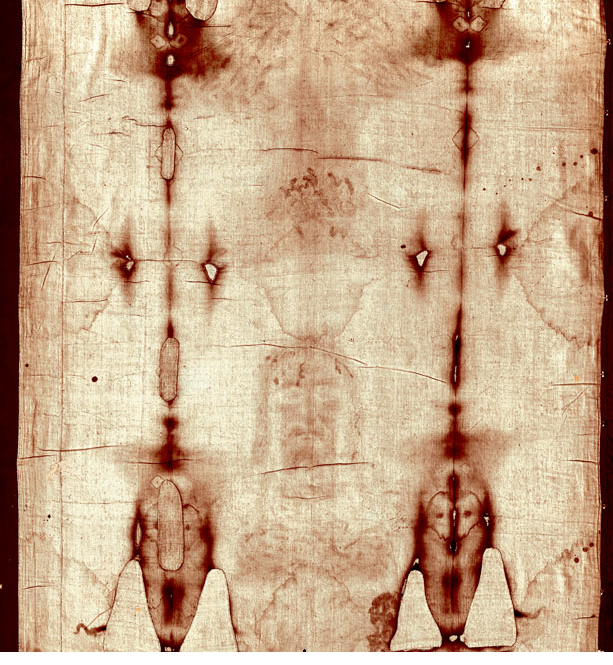 Another problem that the Shroud of Turin faces is that the image of the face is on the body covering, not on a separate piece of cloth for covering the face. This, in and of itself, should raise red flags for the watchmen on the wall, who scan the Christian horizon for aberrancies in matters of doctrine, practice, and discernment in the last days.
What happened to the traditional view of Jewish burials—based on biblical and historical evidence—that the face covering (soudarion) was separate from the body covering (sindon or othonia) and that the face was immediately covered by the face covering? If this traditional understanding is true, then the Shroud isn’t even worth investigating as a possibility for the actual burial cloth of Jesus. The hypothesized resurrection-blast would have left an image of the body on the body covering and a separate image of the face on a separate face covering. But this is not what we see with the Shroud of Turin. Both the image of the head and the image of the face appear on the same piece of cloth. This joint appearance is one of the strongest arguments against the Shroud being Jesus’ actual burial cloth.
Now some defending the Shroud as the genuine burial cloth of Jesus have forwarded the claim that the face covering (soudarion) went over the body covering. For all practical purposes, this makes the face cloth part of the binding straps (keriai) which secured the wrapping or windings to the body. With this arrangement of the face cloth, Jesus’ face could have been miraculously imaged into the body covering.
Unfortunately for the theorists, however, the available evidence from the Bible and historical testimony supports the traditional view that the face covering directly and alone covered the face. This would have left, assuming the theory of a resurrection blast of energy out of the body of Christ, the image of the face on a separate face covering, not on the same piece of wrapping or winding that was used for the body covering.
John 11:44 gives us the biblical precedent. There we find Lazarus coming out of the grave with his body bound hand and foot with keiriai and with his head wrapped with a soudarion. The picture here is that the body and limbs were not only body wrapped with strips of linen cloth, but the hands and feet were bound with linen strips (keiriai) so that the limbs would not be flopping around loose when the body was picked up and carried. The soudarion was not fastened over the top of the body wrapping but immediately on his face. The Greek says, ἡ ὄψις αὐτοῦ σουδαρίῳ περιεδέδετο, “his face was bound with a soudarion.” The soudarion in the Hellenistic world was a utilitarian piece of cloth, in the same category as a bandana or handkerchief, used for mundane things like mopping sweat or blowing the nose. It was, like the bandana, large enough to tie off its ends when using it for things like a funerary face covering or a sling. Nothing in this passage implies or necessitates that the soudarion bound the body wrapping to the face. It plainly states that the soudarion itself bound the face.
We find the same configuration with the account of the resurrection of Jesus in John. “So they ran together, and the other disciple (John) outran Peter, and arrived first at the tomb. And he stooped down, looked in, and saw the linen wrapping lying there, yet he did not enter. Then Simon Peter came behind him and entered the tomb and saw the linen body wrappings lying there. And the soudarion, which had been upon his head, was not lying with the linen body wrappings, but lying in another place, rolled up.”[5] This is two distinct wrappings, not a single wrapping.
Historical testimony from the early Fathers informs us that those in and near to the time of Christ understood that the burial wrappings were used in the traditional configuration. Origen, in his Commentary on John, states regarding Lazarus, “they removed the covering set upon his face and set it aside.”[6] In the same passage he compared the soudarion covering the face of Lazarus with the kalumma that covered the face of Moses. The former was used so folks couldn’t see death on Lazarus’ face. The latter so folks couldn’t see the glory on Moses’ face. This analogy necessitates that the soudarion be placed immediately on the face. Nonnus, in his Paraphrase of John, regards the soudarion as a linen covering that covered the temples as well as the face.[7] In the Acts of Phillip we read, “Truly, this is my vision, for I saw myself bound with a soudarion upon my eyes.”[8] In his commentary on John, Theodore of Mopsuestia wrote, “He removed his garments in order. First he placed and left the soudarion from his head in its own place; and afterwards left the swathing cloth in its own place.”[9] Ephraim the Syrian informs us that the soudarion was othonia (linen wrapping), but it was regarded as distinct from the body wrapping (the other othonia), that the body wrapping was placed in a different pile than the soudarion (face wrapping), and that the soudarion was upon the face.[10] And finally, Severianus informs us that the sindon and the soudarion were separate wrappings and were placed in separate places, and that the soudarion had been used to wrap or bind the head.[11]
In all of these instances, the soudarion was not placed over the body covering (the othonia or sindon), and it was not used as a method of securing the body covering to the body. That was handled by the keiriai, which were narrow linen strips, used for bed supports, bandages, and ties. The soudarion was the covering or wrapping for the face. I was unable to find a single reference in Koine literature that states, implies, or necessitates that the face covering went over the top of the body covering and was used to cinch the body covering tightly on the face.
The Unusual Body Size
Another difficulty that is often overlooked is the unusual size of the image on the Shroud. It is far too large to be an image of the Lord Jesus made by a flash of resurrection glory when the Shroud was wrapped around his body, draped over his body, or stretched flat a few inches above his body. Any man with an authorized picture of the full Shroud, some common sense, and a ruler can estimate with reasonable accuracy the height of the images on the Shroud and thus validate or invalidate this claim.
The Shroud, according to scientific sources, measures 14’4” in length by 3’8” wide.[12] The two images together extend nearly the full length of the Shroud. My own observations, measurements, and calculation are as follows. The feet on the front image are slightly cut off. I ignored that. The feet on the back image are about 2 inches from the edge. There is a narrow gap of about 8 inches between the tops of the heads. I added the two gaps together and got 10 inches. I subtracted 10 inches from 14’4” and got 13’6” for the total length of the two bodies. I divided that by two and got 6’9” for the height of the man.
This corresponds with the estimate made by Lynn Picknett and Clive Prince. Using a photo of the entire Shroud purchased from the Holy Shroud Guild of New York, they measured the man in the front image at 6’8” (203 cm) tall and the man on the back image at 6’10” (208 cm) tall.[13] This unusually large stature catches the Shroud believers on the horns of a dilemma.
If they want to maintain the notion that the image on the Shroud is a resurrection miracle made while Jesus was wrapped or draped with the Shroud or overshadowed by the Shroud, then Jesus was about 6’9” tall. This is far too large for a Jewish man at the time of Christ. Most experts in the field believe that taller Jews in the NT era would have stood between 5 foot 6 inches and 5 foot 8 inches tall. Let’s be liberal and allow Jesus to be 5’10” tall. This means that the man on the Shroud is nearly a foot too tall to be Jesus.
If they want to cling to the corpse being Jesus’ size, say the 5’6” to 5’10’’ range, then they have to forsake the theory that the image on the Shroud was made by a blast of resurrection glory while the Shroud was wrapped around, draped upon, or stretched out over a man. The only way to get an image of the size that we see on the Shroud from a man who was in the 5’6” to 5’10’’ range, barring modern technology, is to use a camera obscura at some distance from the body.
Now the Shroud believers—not surprisingly—have rejected the measurements of doubters like Lynn Picknett and Clive Prince, claiming that they were untrustworthy measurements made by nonprofessionals. The measurements they accept, almost without exception, fall under six feet. But these measurements usually come with admissions (buried in footnotes or tedious paragraphs) that adjustments had been made for various factors like shrinking and stretching. This smacks of a desperate subterfuge to avoid a fatal objection. Using a measuring tape or a ruler to measure things with reasonable accuracy is not a professional skill. It is an every day skill in the same category as dialing phone numbers, counting eggs for a batch of cookies, and estimating miles per gallon. The truth is, the crude measurements can be five percent off, giving us a Jesus who is 6’5’’ tall, and the essential force of the argument still stands.
The Disproportionate Heads
There are numerous anomalies with the images on the Shroud of Turin. One of the most intriguing is the fact that the heads are too small compared to the bodies. The usual ratio between the head and the overall height is 1:8, ranging from 1:7.5 on the exceptionally low side to 1:8.5 on the exceptionally high side. The smaller ratios are typically derived from unusually short people because their heads are often unusually large compared to their bodies.
The images on the Shroud are well outside this range. Picknett and Prince calculated the head to height ratio for the image of the front at 1:8.7 which is significantly outside the normal range. They calculated the head to height ratio for the image of the back side at 1:9.0 to 1:9.4, which is quite extreme.[14] Nicholas Allen’s calculations indicate that the head is about ten percent too small for the body.[15] These two independent calculations are essentially comparable.
The unusual difference in the size of the head compared to the size of the body, for both the front and the back images, implies that the images of the head were made separately from the images of the body. The fact that the image of the back of the head is significantly larger than the image of the front of the head implies the same thing. The evidence, then, suggests that four different images were rendered onto the Shroud.
Right here, another related anomaly comes into play. You would expect, if the images of the head were rendered separately from the images of the body, that there would be some discontinuity where the neck and body connect. Many researchers have noted this very thing. In many of the images there appears to be a thin separation where the neck appears to be cut off at its base and the shoulders appear to be obscured, leaving the head to appear to be floating above the body. Joe Nickell describes this as, “the head is disembodied.”[16] Picknett and Prince say, “Shroudman’s head is—apparently—severed.”[17]
Even committed Shroud believers have acknowledged this anomaly. Picknett and Prince cite a conversation with Ian Dickinson where the latter referred to the head as “dislocated.”[18] Joe Nickell quotes Ian Wilson as saying that the head seems “detached from the rest of the body because of the apparent absence of shoulders.”[19]
This discontinuity, according to Picknett and Prince, even shows up in sophisticated images like the infrared and ultraviolet images taken by STURP and the 3-D images made by John Jackson and Eric Jumper.[20] Andy Haveland-Robinson made computer enhanced images which seem to show a head that is completely separate from the body.[21]
This apparent discontinuity between the head and the body, in size and dislocation, is fatal to the theory that the image on the Shroud is a single image made by a blast of resurrection glory while the Shroud was wrapped around, draped upon, or stretched out a few inches above the body of Christ. While such an image would show the distortion mentioned before, it would not exhibit any discrepancies between the head size and the body size, or between the size of the two heads. But the discrepancies are readily explained if the image on the Shroud is actually four images in composite made by proto-photography with a camera obscura.
The Blood Stains are Problematic
One of the most fascinating observations on the Shroud is that the blood stains were not made by the same process as the images of the front and the back of the man. The image was created by an undetermined method of proto-photography that altered the surface chemistry of the cloth in a manner similar to the chemistry being altered on the negative plate in modern photography.[22] The STURP statement, for all practical purposes, admits this, “No pigments, paints, dyes or stains have been found on the fibrils. … The scientific consensus is that the image was produced by something which resulted in oxidation, dehydration, and conjugation of the polysaccharide structure of the micro-fibrils of the linen itself.”[23] In short, a chemical change left an image on the surface of the Shroud. This image only affects the top two percent, that is the top two micro fibrils, of the threads on the surface.[24]
The blood stains, on the other hand, were physically applied to the cloth and show none of the photo-negative traits of the two images. Now three claims are often made about the blood stains. One, the blood was applied to the cloth while the blood was still fairly liquid, which resulted in blood stains that soak through the cloth and manifest wicking and capillary action in the threads.[25] This does not appear to be debated. Two, the blood stains are actual blood, with compounds like hemoglobin, serum albumin, and bilirubin present.[26] This is debated. For the sake of this paper, I simply assume that the blood is genuine. My position on the Shroud is not materially affected whether the blood is genuine, synthetic, old-tech paint, or iron oxide. Three, when the blood was removed from the fibers that had been pulled from the Shroud, there was no image underneath (no oxidation, dehydration, or conjugation).[27] If true, this means that the blood was applied to the cloth first, and the image was superimposed over it. But others dispute this and complain that this test was based on just one blood-coated fibril (there are more than 100 fibrils per strand of thread), which is not nearly a large enough sample to make a robust test and offer a definitive statement.[28]
Now this combination of supposed factors—the lack of artistic materials on the Shroud, the evidence that the blood is genuine, and the evidence that the image is superimposed over the blood—is regarded by many as proof that the image on the Shroud is the result of a resurrection miracle. The blood was applied to the Shroud when the body was initially wrapped in it, and the image was superimposed on the Shroud later when the Lord rose from the dead. While this sounds plausible, a troubling piece of information challenges it—the correlation between the blood stains and the image is wrong.
If the blood stains were made when the body was 360-degree wrapped or draped with the Shroud, and the image was added by a 360-degree flash of resurrection glory while the body was still wrapped or draped in the same Shroud, then we would see two things when the Shroud was laid flat. One, we would see a single contiguous, distorted image that would display the entire body, all 360 degrees, including the sides and the top of the head. Two, all of the blood stains, without exception, would be on the distorted image. No blood would be off the image except for minor wicking and capillary action. And all of the blood stains would be anatomically correct—they would line up perfectly with the wounded parts of the body on the contiguous, distorted image.
But this is not what we see. We see two distinct images, one of the front and one of the back, which resemble the symmetrical figures in a photograph. And we see discontinuity between the image and the blood stains. While many of the stains are fairly well aligned with the wound areas in the image, some of them are not. And some are not associated with the image at all. Even Russ Breault backhandedly admits this when he says, “When the unwrapped cloth is laid flat, the bloodstain from the underside then appears to be away from the body.”[29] This discontinuity is fatal to the theory that the image was made when the cloth was wrapped around or draped over the body.
Now some, trying to resolve the embarrassment of this difficulty, claim that the body was wrapped long enough for the blood stains to soak into the Shroud, and then the Shroud was unwrapped and stretched out over the Lord, a few inches above his body. But this creates more problems than it solves. First of all, as we have already shown, a 360-degree blast of resurrection glory would leave a distorted image on a burial shroud stretched out above it, not a symmetrical photograph-style image. Secondly, on the basis of what historical sources will men defend the claim that bodies wrapped for burial were later unwrapped, and the same wrapping cloth was then stretched out over the body? Can this theory be demonstrated from historical or archaeological sources? Or is it imagination run amok? Further, the biblical testimony is clear that Jesus’ body was wound with linen strips and spices before it went into the tomb (John 19:38-42) and that his body laid untouched until the resurrection. I find it interesting how quickly men will depart from the plain statements of Scripture if a pet theory requires it. May we all be so beholden to the Scriptures that the plain statements of Scripture ALWAYS trump theories.
Now if Jesus’ body was wound with linen strips, then we have only two options for the sheet that his body was wrapped in when he was taken off the cross. Either the sheet stayed on the body and was under the windings until the resurrection, in which case the blood stains and the image would be perfectly aligned on the tightly wrapped sheet. Or the sheet was removed before the windings were added, and the windings were directly upon the body, in which case there would be no sheet that could be emblazoned with the image of Jesus in his resurrection.
This information allows us to conclude beyond all shadow of doubt that the images on the Shroud were not made by a flash of resurrection glory which emanated from the Lord’s entire body while he was wrapped in or draped with the Shroud.
The Pollen Proves Nothing on Origin or Provenance
One of the most commonly trumpeted claims for the Shroud actually being the burial cloth of Jesus is the pollen research of Max Frei. Supposedly, he identified 56 distinct species of pollen on the Shroud,[30] most of them native to the Middle East and Anatolia, and 7 of them unique to the Jerusalem area. This information is touted as proof that the Shroud had its origin in the Jerusalem area and spent significant time in the Anatolian Plateau. Now this claim would be a profound revelation were it true. But it is more wishful thinking than science.
First of all, it is well-known in the field of palynology, which is the study of pollen, that definitive identification of the genus can be problematic and definitive identification of species is typically problematic. This factor alone relegates the trumpeted claim to the realm of dubious. Experts in the field are baffled by the claim that Frei identified 56 varieties of pollen precisely down to the species. Joe Nickell’s writes, “Smithsonian botanist Richard H. Eyde (1986) observed that the real problem with Frei’s work was that he claimed to do that which was suspect. Eyde noted that pollen identification ‘is not to species save in rare cases; rather it is this or that type of [pollen] grain—or to genus or species-group.’ He [Eyde] added; ‘This is so well known, that the burden of proof is on the one who says he’s identified a species by its pollen. The identifier must say what traits separate the identified grain from grains of related plants.’”[31]
A reviewer wrote in the BSTS Newsletter, “Max Frei found Pistacia and Cistus (and narrowed them to individual species, which lacks credibility and casts a shadow over his identification).”[32]
Marcia Boi wrote, “Without a doubt, under the Frei’s adhesive tapes, there are present a few pollen that belong to this family of plants [Compositae or Asteraceae] and the probability of falling in mistake in the identification to level of species is very high … All palynologist, knows that, for a correct identification, it is necessary the observation through the electron microscope (SEM), because is not sufficient the observation with only the optical microscope (MO).”[33]
Secondly, a thick layer of shellac-like wax, called exine, naturally coats pollen grains. This layer on the grains reduces the ability for experts to positively identify the pollen. Dr. Thomas Litt wrote, “waxes … cover the structure and sculpture of the pollen grains. This is the reason why I cannot make a precise identification of the pollen at the genus level, even less at the species level.”[34]
Thirdly, the identification of the most common variety of pollen found on the Shroud, which comprises 29.1 % of the pollen grains on Frei’s sticky tapes, is debated among the amateurs and experts who have labored in the field.[35] This was identified by Frei (1983) and Danin (1999) as the genus Gundelia, a thorn from the sunflower family.[36] Dr. Thomas Litt rejected this identity. He stated, “With a high probability, I can exclude that the pollen I have seen on the sticky tapes belong to Gundelia.”[37] Marzia Boi regarded this variety to actually be various species of the genus Helichrysum (sunflowers).[38] Indeed, the identity of many of the varieties of pollen grains on the Shroud has been disputed. This debate alone could consume weeks of reading.
Fourthly, the data behind this amazing claim by Frei is based on unpublished research. This raises a big question in the minds of many scientists who have grappled with the subject. What identification technique allowed Frei to discern both genus and species where current techniques struggle to identify the genus definitively? Picknett and Prince write, “Astonishingly, although he published his conclusions, his detailed paper showing how he reached them remains unpublished, even after thirty years, despite the fact that making all the data publicly available is normally a prerequisite for publishing a scientific paper. (Frei died in 1983, but his manuscript is owned by the American pro-Shroud group ASSIST—the Association of Scientists and Scholars for the Shroud of Turin, Inc.—which also has his original tape samples.)”[39]
Fifthly, the genuses of the identified pollen varieties are widespread across Eurasia, Europe, and Mediterranean Region. No data patterns present themselves which suggest any region as the origin, or suggest any particular path of provenance over the centuries. Nothing allows a man to point to the Levant, much less Jerusalem, as the location where the Shroud began its journey.
Sixthly, the presence of pollen on the Shroud that might derive from aromatic plants does not prove that aromatic substances were placed on the Shroud in preparation for burial. The pollen on the Shroud was most likely transmitted in the air as dust and by contact with skin and clothes on which the pollen had settled. It would be highly unlikely that a few traces of aromatic pollen grains remained from a burial preparation with ground spices but the solids from those spices somehow completely vanished.
The more you look into the pollen on the Shroud, the more you find yourself inclined to agree with Joe Nickell when he wrote, “It now appears that the pollen study was an exercise in either self-deception or outright scientific fraud.”[40]
The DNA Proves Contamination
An area of research that has not received sufficient attention, at least in the popular books and presentations, is the variety and identity of the DNA that has been found on the Shroud. The findings of this research are simply astounding. The Shroud believers typically either ignore this research or they blame the results on bogus methodology or modern contamination from careless scientists who didn’t follow proper research protocols.
One astounding fact is that there is a very significant presence of plant DNA on the Shroud from species that originated in South and Meso America and didn’t arrive in Europe and the Mediterranean Region until the Columbian Diffusion, that is, after Columbus’s exploratory voyage to the New World. These include hot peppers, tomatoes, potatoes, and peanuts. The presence of these species points to contamination that happened in the 1500s and later. This information is explosive and shouldn’t be ignored or explained away. The Shroud never visited South America or Central America. Therefore, the DNA cannot be trusted to tell us a story about where the Shroud has been. The most likely explanation is that the vast majority of the DNA contamination is due to post-Columbian-Diffusion visitors coming to the Shroud—even handling and kissing it—not the Shroud passing through the region where the plants are native on its circuitous journey to Turin.[41]
Another astounding fact is that 39% of the human DNA found on the Shroud is of Indian sub-continent derivation. The three largest haplogroups from this region are R8, M56, and M39. At no time in the known history of the Shroud was there ever a high enough percentage of Indian sub-continent custodians and visitors to even begin to explain this anomaly. The most plausible explanation is that the linen (either the thread or the finished textile) was manufactured in the Indus region.[42]
Now this DNA contamination is problematic for the theory that the pollen on the Shroud can help us trace the provenance of the Shroud from Jerusalem to Anatolia to its current resting place in Turin. The pollen contamination is best explained by the same people and conditions that caused the DNA contamination. If the DNA is largely contamination from people that visited or handled the Shroud, then the pollen is largely contamination from people that visited or handled the Shroud, tracking the pollen in on their clothes and skin.
Where are the Spices?
No definitive evidence for burial spices, oils, ointments, or perfumes has been detected on the fabric of the Shroud though various studies have sought such evidence. The official statement from the STURP team says, “Micro-chemical evaluation has indicated no evidence of any spices, oils, or any bio-chemicals known to be produced by the body in life or in death. It is clear, there has been a direct contact of the Shroud with a body, which explains certain features such as scourge marks, as well as the blood.”[43]
This is a bombshell revelation against the Shroud being the actual burial cloth of the Lord Jesus. The biblical account is clear that Jesus’ body was annointed with one hundred litras of aloes and myrrh (John 19:38-40).[44] If the Lord were wrapped in the Shroud, then wrapped and bound with linen strips and the spices (John 19:40), there would still be traces of these spices on the Shroud yet today. It is impossible that the Shroud or any other linen cloth could be wrapped around a body, then wrapped and spiced per the biblical account, sit in this condition for three days, and bear zero evidence of this spice.
The effort to overthrow this difficulty with the claim that the spices dissipated with the passing of time can’t be allowed. The amount of DNA, pollen, minerals, and other contaminants that have been found on the Shroud is a fatal objection to this claim. These contaminants were the result of a far less invasive and extensive contamination of the Shroud than the administration of the spices. The total amount of contamination—DNA, pollen, minerals, and other contaminants—that came in contact with the Shroud over the centuries (through dust, touch, breath) is almost certainly less than one percent of the mass of the spices. But let’s be liberal and say that 0.75 pounds of these contaminants came in contact with the Shroud over the centuries. Now the fact that this minor, accidental, and momentary contamination has left readily discoverable traces on the Shroud poses a conundrum for the Shroud faithful. How is it that scientists can readily find traces of the minor, accidental, and momentary contamination, yet can’t find any trace of an intentional contamination that was one hundred times bigger in mass and forcibly pressed into the linen for three days? This is an impossibility.[45]
The Supposed 3D Information
One of the most vaunted arguments for the Shroud being the product of a resurrection miracle is the claim that the VP-8 pictures of the Shroud reveal 3D information. If true, this is an extremely unusual property that seems to demand miraculous generation. This claim has revolutionized the argument that the Shroud is the burial cloth of Jesus, juicing it with the apparent substantiation of scientific evidence. But this claim is a misinterpretation of the data.[46] It is running to a sensational interpretation of the data when a mundane interpretation is readily available.
The VP-8 Image Analyzer (and any similar machine or software), interprets the intensity of the image (the darkness seen by the naked eye or the brightness seen in the negative) as distance. This interpretation can render an image into an apparent 3D picture by showing the darker areas as lower elevation and the lighter areas as higher elevation. But this is not actually encoded 3D information. This is simply transposing light intensity data into an apparent 3D portrayal.[47]
The apparent three-dimensionality evidenced with the image on the Shroud of Turin is not a miracle but a phenomenon that can be easily replicated with a home experiment. Take any kind of porous paper (like toilet paper, tissue paper, paper towel, or coffee filter), put a drop of ink or food coloring on it, and watch the liquid spread. It will form a dark center and fade into lighter rings as the coloring moves outward. Now process this image with 3D image analysis software. The result will resemble a mountain with sloping sides. The processed image will have the appearance of three-dimensionality, but the original image had zero encoded three dimensionality.[48] This, in and of itself, presents a serious challenge to the interpretation of the VP-8 renderings of the Shroud as proof of coded three-dimensionality in the image and therefore proof of its miraculous generation.
But another problem arises with the supposed 3D interpretation. The output that it presents for the face and the body are significantly different. If the analyzer is set so that it presents the face in a way that appears to be natural relief, then both the front and back of the body barely stand out. If the analyzer is set so that it presents the body in apparent natural relief, then the facial features stand out far too much. This implies that the image of the face is not the same image as the image of the front and back of the body. The two images were created at different times with different settings and distances.[49]
Wide-Angle X-Ray Diffraction
The believers in the miraculous origin of the Shroud of Turin were chagrined when their original dating effort with carbon dating gave them a medieval age that supported the theory of medieval forgery. So they turned to wide-angle x-ray diffraction. This method gave them a new lease on life when it yielded the date range that they sought, dating back two thousand years to the time of Christ. Since then, wide-angle x-ray diffraction has become a core part of the scientific argument for “proving” that the Shroud actually is the burial shroud of Jesus.
Now this would be a very significant piece of evidence were the date range obtained by this technology completely above board. But the methodology used to date the Shroud is suspect. It used a testing process whose dating scale is based on the assumption that humidity and ambient temperature remained relatively stable since fabrication.
Let’s first explain what wide-angle x-ray diffraction is. It is a method for analyzing materials, especially crystalline materials, and determining their structural properties. It is highly accurate in this regard. But when wide-angle x-ray diffraction is used in reference to determining the age of linen, this is referring to a very specific use of the technology, pioneered by Dr. Liberato De Caro of Italy’s Institute of Crysallography of the National Research Council, for determining the age of NATURAL-AGED flax cellulose. It measures the current structural properties of a sample of linen, compares it to the structural breakdown properties of linen over time under the natural aging process, and converts the data in a calculation of how much time has elapsed since fabrication.
When used within the confines of its limitations, this test is fairly accurate. However, this method depends on RELATIVELY STABLE HUMIDITY AND AMBIENT TEMPERATURE during the aging process of the linen without any significant environmental effects that might skew the test. It cannot give correct readings if the linen to be tested has been affected by skewing effects like heat, light, bright light, sunlight, high temperatures, low temperatures, fire, water, high humidity, smoke damage, and chemical damage from cleansing.
The Shroud was exposed to all of the above at one time or another, and nobody knows exactly how much accelerated decay to bake into the equation. In the Chambery Fire in 1532, for just one instance, the Shroud was exposed to such intense heat that the silver box it was held in melted, and silver dripped onto the cloth, burning through the folded layers and scorching areas along both sides. Given the unknown but very significant amount of accelerated aging accumulated through the centuries with various adverse environmental conditions, it is impossible to accurately date the age of the Shroud of Turin with wide-angle x-ray diffraction. The truth is, the accelerated aging could easily account for 1000 to 1500 years of the 2000 year result that was obtained.
The Image Can Be Replicated
The claim is often made that the image can’t be replicated by modern science, therefore it must be a resurrection miracle. This is simply not true. Ian Wilson, a well-known Shroud advocate, confessed in 1995 in the journal of The British Society for the Turin Shroud (BSTS), “The highly important feature of his [Nicholas Allen’s] hypothesis is that he is the first (at least in this reviewer’s opinion), to have produced a convincing replication of the Shroud image.”[50] This was reported over thirty years ago in one of the best known Shroud journals by one of the most famous Shroud advocates. So why is this false claim still being repeated?
Nicholas Allen’s effort to replicate the Shroud is certainly intriguing. He demonstrates that the image could have been made in the Middle Ages by a proto-photographic process which employed a camera obscura and three materials readily available and commonly used at that time: linen, either silver nitrate or silver sulphate, and ammonia (which could be from any of several sources including urine). The cloth would be wetted with a solution of one of the silver compounds, dried, stretched inside the camera obscura, and then exposed to sunlight reflecting off the body. The image results from the darkening that occurs when the silver reacts with the sunlight. The depth of color is proportional to the intensity and amount of sunlight received. The process could be accelerated with a quartz lens in the aperture. The image is fixed by soaking the cloth in ammonia which removes the silver ions and stops the process. The ammonia is then rinsed from the cloth with the image. The resultant image is yellowish/brownish, similar to the discoloration of cotton or linen under natural aging or when exposed to heat.[51]
Other researchers have attempted to replicate the image with greater or lesser success using materials and methods available in the Middle Ages. Two efforts stand out in my mind as worthy of mention. The first is the experiment of Clive Prince and associates with a camera obscura which proved the feasibility of medieval proto-photography using common materials. They used a camera lens for maximizing the light that could be concentrated on the cloth, a plastic head and a lifesized bust of a girl, and a mixture of ammonium bichromate (sensitizer), egg white (the organic mix), and urine (which enhanced the discoloration). The mixture was painted on the cloth. After it dried the cloth was stretched out on the frame in the camera obscura. After the image was baked on the cloth via the light source (they tried both sunlight and ultraviolet lamps), the image was fixed and the cloth rinsed. The result was an image that reasonably replicated the features of the image on the Shroud of Turin.[52]
The second is the effort of Luigi Garlaschelli who utilized a rubbing technique and materials that were readily available in the Middle Ages. He placed a linen sheet flat over a volunteer and rubbed it with a pigment mix that contained a trace amount of acid. He used a bas-relief for the face. When the cloth was artificially aged with heat and washed, the resulting image left a hazy, half-tone image that clearly resembled the image on the Shroud. The replica was amazing enough that Mark Guscin, a Shroud advocate, was forced to admit the likeness.[53]
With this kind of evidence readily available, why are men still cowering before the claim that science is unable to replicate the style of image found on the Shroud?
The Contrary Evidence in Total
In the preceding sections, we observed fourteen arguments that testify against the Shroud of Turin being the actual burial cloth of Jesus. Some of them are likely strong enough to carry the point alone. But together, undoubtedly, they make a conclusive case. ONCE you understand that the image on the cloth looks nothing like the image you would see were Jesus’ image actually blasted onto his burial cloth by a blast of resurrection glory, ONCE you embrace the fact that Jesus’ face would have been blasted on a separate face cloth, ONCE you submit to the inconvenient fact of the highly unusual body size, ONCE you deal honestly with the disproportionate heads, ONCE you allow the truth of the biblical testimony that Jesus’ body was actually wound with strips and spices, ONCE you embrace the facts of the DNA, the dubiousness of the pollen claims, and the lack of spice residue, ONCE you deal honestly with the entire lot of contrary evidence, then you will be forced to admit that it is impossible for the Shroud of Turin to be the actual burial cloth of Jesus that was miraculously graced with his image by a 360-degree blast of glory in his resurrection.
Many more anomalies could have been articulated about the Shroud, the image, the blood, and the supposed history of the Shroud that would lengthen this treatment to a full volume. But they would not have strengthened the argument in the sense of increasing the degree of certainty. They would merely have exposed the weakness of the pro-arguments on many further fronts.
Rightly Framing the Debate
So if the Shroud is definitely not a resurrection miracle, then what is it? It is simply a manmade image. Full stop. That is all that must be proved. It is irrelevant whether it was made to be a fraudulent relic or a non-fraudulent icon, or whether its manufacture originally had nothing to do with Jesus at all, and it was later exploited. Perhaps it was a mere scientific endeavor that wasn’t published because the inventor or his associates feared the accusation of witchcraft—a frequent and serious charge in the Middle Ages. I don’t mean, of course, that the motive behind the Shroud is absolutely irrelevant but only that it is relatively irrelevant. I make this point because Shroud believers typically frame the debate in a manner that makes excessive demands for invalidation. Men must point to the motive, the method, and the man, or their invalidation efforts are scorned and rejected. But this is a subtle method of begging the question, and this method is par for the course when superstition gets in a dogfight with the scientific method. The superstitious defend their turf with a demand for proof that no man can provide, and then rejoice in their indomitable “truth.”
The truth is, we don’t have to finger the motive, the culprit, or the technique of manufacture to disprove the Shroud, that is, to prove that the Shroud is not the actual burial cloth of the Lord Jesus graced with his image in a miraculous blast of energy at his resurrection. You don’t have to finger the counterfeiter and the technique to prove that twenty-dollar bills are counterfeit. You only have to prove that they are not genuine. If the heads on the bills are wrong for the body size, if things are missing or disproportionate, or if things are not properly aligned, then the bills are counterfeit and must be rejected as such. Were a judge to toss a case of counterfeit money out the window because the prosecution couldn’t finger the culprit or the precise method employed, he would be guilty of gross abuse of his office.
In the same way, when the defenders of the genuineness of the Shroud toss all evidence and claims that it is manmade out the window because their opponents can’t finger the guilty party or specify the technique or technology employed, they prove their prejudice and lack of integrity in the matter. While it would be pretty cool to sleuth out the culprit and the method, we are under no obligation to do so. We have one obligation. Present evidence that the Shroud does not line up with what the burial cloth of Jesus would look like were it miraculously blasted with his image in his resurrection. This obligation has one minor obligation associated with it. Demonstrate that there were plausible options for production in the Middle Ages, that is, that the technologies were known and used in the Middle Ages.
The Best Explanation for the Shroud
In my estimation, the best explanation for the image on the Shroud is proto-photography with a camera obscura—the blood and maybe the hair being added separately. The image on the cloth clearly belongs in the photography class and manifests photo negative qualities. This was the view of Nicholas Allen. He wrote, “If one reviews the findings of the 1973 and 1978 STURP commissions, both of which carefully analysed the characteristics of this seemingly paradoxical image, one can only conclude that some form of radiated energy (heat or light) could have formed the image, and arguably the simplest way to produce an image by a form of radiated energy is by employing some form of photographic-related technology.” [54]
Some have tried to ward off this solution with the high-browed observation that photography wasn’t invented until centuries later. But we aren’t arguing for modern photography. We are arguing that the technology for proto-photography with a camera obscura existed in the Middle Ages. This cannot reasonably be rejected. Every necessary component of proto-photography was long established and exploited in the Middle Ages.
The camera obscura is an ancient technology. In the fourth century BC, Aristotle studied techniques for exploiting light with a camera obscura and lenses to make inverted images. In the Middle Ages, the camera obscura was popular for viewing celestial events like eclipses and tracing pictures. It is only one simple step to move from manually tracing an image to using sunlight to etch the image on a surface prepared with light sensitive material.
Exploitation of light sensitive materials goes deep into ancient times. The purple dye that the Romans used was derived by a light sensitive process, the original yellow turning purple when exposed to sunlight. In the Middle Ages there was a tremendous amount of research with light sensitive materials like silver salts and mercury salts, both sometimes being used to color wood, leather, and tile.
Ammonia salts were used in the Middle Ages for many practical purposes in the home and in industry: neutralization, stain removal, cleaning jewelry and silver plate, general detergent, and altering the color of vegetable dyes.
When you understand how well and long established these technologies were, it is not hard to imagine some brilliant mind in the Middle Ages figuring out how to combine all three: the camera obscura, silver salts on stretched cloth, and ammonia for cleaning the linen and setting the image. Indeed, Nicholas Allen imagined this and embarked on his own journey to replicate the style of image found on the Shroud. He writes, “Since 1990 the author has formally conducted a number of experiments which have employed the kind of technology available to certain medieval societies c.1200-1350 AD, and has shown that it is quite possible to produce a chemically stable (fixed) negative photographic image of a human corpse on a piece of linen employing only three substances, all of which were available to people living well before the thirteenth century. These substances are quartz (rock-crystal), the silver salts (specifically silver-nitrate (eau prime and silver) and/or silver sulphate (oil of vitriol and silver) and ammonia (urine).”[55]
Some have complained that if the process of proto-photography was discovered in the Middle Ages, why wasn’t it retained? The answer is right at their fingertips. History is filled with instances of technological advances that were lost. Dozens of volumes have been written on the mysteries of anomalous archaeology and lost technology. The megalithic cultures used unknown primitive technology for carving and moving massive blocks of stone. The Romans invented a concrete that is superior to modern concrete. That technology was lost for many centuries before an inferior concrete was reinvented. Leonardo da Vinci devised a photometer to measure the brilliance of light. But his invention was lost, and it was not reinvented until the late 18th century. Bearing this pattern of lost technology in mind, it is not a big stretch to imagine that proto-photography was invented in the Middle Ages, then lost, then invented again in the late 1700s and early 1800s.
Conclusion
Sadly, the true believers in the Shroud are not likely to be persuaded by this information. They will pooh-pooh it and claim I am ignoring their evidence. They will claim that I am recycling debunked theories. They will ignore all the contrary evidence. This is to be expected. If men want to strain out gnats and swallow camels, you cannot stop them. If men want to be sucked into the vortex of superstition and resist the pleas of sola scriptura, the historical-grammatical hermeneutic, and the scientific method, then you cannot keep them from going under.
People can dispute the facts all they please, but the stubborn facts will remain. The facts of the Shroud demand some form of proto-photography, and the facts of history inform us that all the pieces of the technology for proto-photography were in active use in the Middle Ages. It is ten times easier for me to imagine a medieval scientist anticipating proto-photography when all the pieces of the technology were already in use than it is for me to imagine the Lord doing all of the following: leaving a flat, photo-style image on his burial cloth though he was wrapped or draped in it, leaving the blood on his burial cloth but erasing the spices, mismatching his blood stains and his image, stretching the image of his body 15 to 20%, mismatching his body size and head size, placing his face image on his body sheet, and keeping his miraculous image a secret for well over a thousand years before revealing it to the Catholics. How does this latter point not belong in the same category as Joseph Smith and his peep stones? The God of order did a pretty chaotic work here if this was his handiwork.
Eyes wide open, brain engaged, heart on fire!
Lee W. Brainard
August 17, 2026
[1] Prior to 1998 the dimensions were usually cited as 14’3” X 3’7” (434.3 cm X 109.2 cm). In 1998 the ancient textiles expert Dr. Mechthild Flury-Lemberg determined that the true measurement was 14’4” X 3’8” (437 cm X 111 cm). Measurements made by Bruno Barbaris, Director of the International Centre of Sindonology in Turin, and Gian Maria Zaccone, Scientific Director of the Shroud, after the 2002 restorations, came to similar results, 438 cm X 113.3 cm, (14’4” X 3’9”). See https://theshroudofturin.blogspot.com/2020/04/dimensions-shroud-of-turin-burial-sheet.html.
[2] The official summary of STURP’s conclusions in non-technical language, which was distributed after the final STURP meeting in October 1981.
[3] John Walsh, The Shroud, Random House, 1963, p. 9. As cited from Russ Breault, Shroud Encounter, p. 16.
[4] Dr. David Johnson of Kings College notes in the New York Post, “If the shroud were wrapped around a body, it would leave a distorted image.” https://nypost.com/2024/08/22/lifestyle/new-shroud-of-turin-evidence-supports-christs-death-by-crucifixion/.
[5] John 20:4-7. The Greek runs, ἔτρεχον δὲ οἱ δύο ὁμοῦ, καὶ ὁ ἄλλος μαθητὴς προέδραμε τάχιον τοῦ Πέτρου καὶ ἦλθε πρῶτος εἰς τὸ μνημεῖον, καὶ παρακύψας βλέπει κείμενα τὰ ὀθόνια, οὐ μέντοι εἰσῆλθεν. ἔρχεται οὖν Σίμων Πέτρος ἀκολουθῶν αὐτῷ, καὶ εἰσῆλθεν εἰς τὸ μνημεῖον, καὶ θεωρεῖ τὰ ὀθόνια κείμενα, καὶ τὸ σουδάριον ὃ ἦν ἐπὶ τῆς κεφαλῆς αὐτοῦ οὐ μετὰ τῶν ὀθονίων κείμενον, ἀλλὰ χωρὶς ἐντετυλιγμένον εἰς ἕνα τόπον.
[6] Origen (c. 185 to c. 254), Commentary on John, book 28, chapter 7. The Greek says, καὶ ἀποθῆται τὸ ἐπικείμενον αὐτοῦ τῇ ὄψει κάλυμμα ἀφαιρεθέν, which is a comment on the Bible’s ἡ ὄψις αὐτοῦ σουδαρίῳ περιδέδεται. The soudarion, according to Origen’s understanding, was a cover that was set immediately upon the face.
[7] Nonnus (5th cent.), Paraphrase of John, Dem. 11, lines 170-173.
[8] Acts of Phillip (4th cent.), chap. 14, sect. 4. The Greek runs, The picture here is that the body and limbs were not only body wrapped with linen cloth, but the hands and feet were bound with linen strips (keiriai) so that the limbs would not be flopping around loose when the body was picked up and carried.
[9] Theodore of Mosuestia (c. 350 to c. 428), Commentary on John, fragment 136. The Greek runs, κατὰ τάξιν ἀφελὼν τὰ ἱμάτια ἰδίᾳ ἔθηκε τὸ σουδάριον τὸ πρῶτον λειφθὲν ἀπὸ τῆς κεφαλῆς, ἰδίᾳ δὲ τὰ ὀθόνια τὰ ὕστερον λειφθέντα.
[10] Ephraim the Syrian, Sermon on the Resurrection, Phrantzolas, vol. 7, pp. 57-58. The pertinent stretches in Greek run as follows, Ἔκειντο καὶ τὰ ὀθόνια, παρὰ μέρος δὲ καὶ σουδάριον, ὅπερ ἂν εἴη προσμάγιον, τοῦτο γὰρ παρ’ Ἑβραίοις σουδάριον λέγεται … Διατί δὲ τὸ σουδάριον κατ’ ἰδίαν ἔκειτο κεχωρισμένον τῶν ἄλλων ὀθονίων. I translate this as follows: “The othonia were set apart from the soudarion, which would be a face covering, for this is called a soudarion by the Hebrews. Therefore the soudarion was placed by itself, separate from other linen wrapping cloths.” The word προσμάγιον isn’t listed in Liddel and Scott, but it is found in Lexikon zur byzantinischen Gräzität (LBG), where it is rendered Gesischtstuch “face piece.”
[11] Severianus (died c. 452), In mundi creationem, Homily 5, Migne, vol. 6, col. 483. The Greek runs, Διατί εἶδον τὰ ἱμάτια καὶ τὴν σινδόνα εἰς ἓν μέρος, καὶ τὸ σουδάριον παρὰ μέρος, ᾧ ἡ κεφαλὴ ἐδέδετο ἡ σωτήριος.My translation runs, “Why did I see the garments and the sindona in one place and the soudarion, with which the Saviour’s head had been bound, in another place?”
[12] Prior to 1998 the dimensions were usually cited as 14’3” X 3’7” (434.3 cm X 109.2 cm). In 1998 the ancient textiles expert Dr. Mechthild Flury-Lemberg determined that the true measurement was 14’4” X 3’8” (437 cm X 111 cm). Measurements made by Bruno Barbaris, Director of the International Centre of Sindonology in Turin, and Gian Maria Zaccone, Scientific Director of the Shroud, after the 2002 restorations, came to similar results, 438 cm X 113.3 cm, (14’4” X 3’9”). See https://theshroudofturin.blogspot.com/2020/04/dimensions-shroud-of-turin-burial-sheet.html.
[13] Lynn Picknett and Clive Prince, The Turin Shroud, p. 221. The fact that the image of the front is shorter than the image of the back is yet another evidence that the two images are distinct images made at distinct times.
[14] Lynn Picknett and Clive Prince, The Turin Shroud, pp. 225-226.
[15] Nicholas Allen, Turin Shroud: Testament to a Lost Technology, p. 162. Allen used the ratio of the distance across the eyes compared to the width of the hand.
[16] Joe Nickell, Inquest on the Shroud of Turin, p. 70.
[17] Lynn Picknett and Clive Prince, The Turin Shroud, p. 301.
[18] Lynn Picknett and Clive Prince, The Turin Shroud, p. 216. Ian admitted when he first met the Picknett and Prince team at an exhibition in Bath, “I’ve been over this image with a fine-tooth comb and there is something very peculiar about it: the head appears to be dislocated.”
[19] Joe Nickell, Inquest on the Shroud of Turin, p. 70. Ian Wilson is quoted from his work, The Shroud of Turin, rev. ed., Image Books, 1979, p. 22.
[20] Lynn Picknett and Clive Prince, The Turin Shroud, p. 216.
[21] Lynn Picknett and Clive Prince, The Turin Shroud, pp. 320-321.
[22] The image on the Shroud is a photographic image, regardless of whether it is a manmade or miraculous product.
[23] The official summary of STURP’s conclusions in non-technical language, which was distributed after the final STURP meeting in October 1981.
[24] Russ Breault, Shroud Encounter, pp. 34, 36. The same observation is made by others. This observation is based on the work of the STURP scientists and those who followed in their train.
[25] Lynn Picknett and Clive Prince, The Turin Shroud, p. 36. The capillary action along the fibers is not as pronounced as it would be with fully liquid blood.
[26] The official summary of STURP’s conclusions in non-technical language, which was distributed after the final STURP meeting in October 1981, said “The blood stains are composed of hemoglobin and also give a positive test for serum albumin.” Russ Breault, Shroud Encounter, p. 29. See also his comments on p. 33. The bilirubin is mentioned on p. 68. Bilirubin is not normally in the bloodstream, unless the liver is not functioning properly, which can happen under severe stress.
[27] Russ Breault, Shroud Encounter, p. 34. The same observation is made by others. This observation is based on the work of the STURP scientists and those who followed in their train.
[28] Lynn Picknett and Clive Prince, The Turin Shroud, p. 37. This test was performed by STURP scientist Alan Adler, who applied a protein-dissolving chemical to the fibril which dissolved the blood.
[29] Russ Breault, Shroud Encounter, p. 64.
[30] This claim is based entirely on the work of Max Frei, a Swiss criminologist, amateur palynologist, and true Shroud believer. Ian Wilson’s book, The Shroud of Turin: The Burial Cloth of Jesus Christ?, Image Books, 1979 includes a whole chapter on Frei’s work (pp. 77-81), and in an appendix lists 49 species of pollen samples found on the Shroud which had been identified by Max Frei (pp. 293-298). Later on, Frei claimed in a journal article that he had identified at least 56 distinct pollen varieties. See “Nine years of palynological studies on the Shroud” in Shroud Spectrum International, 1(3): 3-7, June 1982. Cited from Joe Nickell’s article, “Pollens on the ‘Shroud’: A Study in Deception,” Skeptical Inquirer, Vol. 18, Summer 1994, pp. 379-385.
[31]Richard Eyde, Letter to Joe Nickell, March 18, 1986. (See also his letter to National Geographic, February, 1985). Cited from Joe Nickell’s article, “Pollens on the ‘Shroud’: A Study in Deception,” Skeptical Inquirer, Vol. 18, Summer 1994, pp. 381-382. This same quote is also found in Lynn Picknett and Clive Prince, The Turin Shroud, p. 76.
[32] BSTS Newsletter, No. 84, Part 5, Publications (1), being a review of “Pollen on the Shroud of Turin: The Probable Trace Left By Annointing and Embalming” by Marzia Boi, University of the Balearics. The BSTS Newsletter is published by the British Society for the Turin Shroud.
[33] Marcia Boi, her published paper titled, The Ethnocultural significance for the use of Plants in Ancient Funerary Rituals and its possible implications with pollens found on the Shroud of Turin, p. 12. She writes in broken English.
[34] Dr. Thomas Litt, a well known palynologist, wrote this in his report to CSST (Council for the Study of the Shroud of Turin) following his research on some of Frei’s slides in June 2001 in his laboratory at the Institute of Paleontology of the University of Bonn.
[35] According to Marcia Boi, The Ethnocultural Significance …, pp. 9-10, there are 313 pollen grains contained on Frei’s 23 sticky tapes (22 from 1978 and 1 from 1973).
[36] Marcia Boi, The Ethnocultural Significance …, p. 10.
[37] Avinoam Danin, Botany of the Shroud, 2010, p. 68. Dr. Thomas Litt was a well known palynologist, who worked at the Institute of Paleontology of the University of Bonn.
[38] Marcia Boi, The Ethnocultural Significance …, p. 18.
[39] Lynn Picknett and Clive Prince, The Turin Shroud, pp. 74-75.
[40] Joe Nickell, “Pollens on the ‘Shroud’: A Study in Deception,” Skeptical Inquirer, Vol. 18, Summer 1994, p. 379.
[41] See Nature.com, “DNA signatures preserved in the official 1978 sample collection of the Shroud of Turin”; https://www.nature.com /articles/s41598-026-60684-7. Authors are Gianna Barcaccia, Nicola Rambaldi Migliore, Giovanni Gabelli, and 16 others.
[42] See Nature.com, “Uncovering the source of DNA found on the Turin Shroud,” by Gianna Barcaccia, Guilio Galla, Alessandro Achilli, Anna Olivieri, and Antonio Torroni; https://www.nature.com/articles/srep14484.
[43] Thibault Heimburger, “Comments about the Recent Experiment of Professor Luigi Garlaschelli,” Shroud.com, 2009, 1-3, www.shroud.com/pdfs/thibault-lg.pdf.
[44] A litra is about twelve ounces. So the Lord’s body was treated with about seventy five pounds of spices.
[45] Further, there is no help to be gained by appealing to evaporation, whether over the centuries or in the Chambery Fire in 1532. There would still be traces of the spices on the Shroud long after the volatile oils had dried out.
[46] See shroudstory.com, where Dan Porter has posted various articles on the VP-8 Analyzer output. See also Lynn Picknett and Clive Prince, The Turin Shroud, pp. 228-237.
[47] Lynn Picknett and Clive Prince, The Turin Shroud, pp. 228 ff.
[48] Shroudstory.com, Dan Porter, various articles on the VP-8 Analyzer output.
[49] Lynn Picknett and Clive Prince, The Turin Shroud, pp. 228 ff.
[50] Review of Nicholas P. Allen’s paper, “Verification of the Nature and Causes of the Photonegative Images the Shroud of Lirey-Chambery-Turin” De Arte 51, Pretoria, UNISA, 1995, pp.21-35, by Ian Wilson in BSTS Newsletter No. 42 Part 5, https://www.shroud.com/pdfs/n42part5.pdf.
[51] See Nicholas Allen’s book, The Turin Shroud and the Crystal Lens, or the updated version, Turin Shroud: Testament to a Lost Technology. A synopsis can be found in his published paper , “Verification of the Nature and Causes of the Photonegative Images the Shroud of Lirey-Chambery-Turin” De Arte 51, Pretoria, UNISA, 1995, pp.21-35.
[52] Lynn Picknett and Clive Prince, The Turin Shroud,pp. 248-273. All of ch. 8, Positive Development, is worth reading.
[53] See the article on his effort by Antonio Lombatti, titled “Remaking the Shroud—National Gegraphic,” posted on the arizona.edu website, https://bibleinterp.arizona.edu/articles/turin358031. The article was based on a program aired by National Geographic TV called “Remaking the Shroud.” Luigi’s work was inspired by the hypothesis and demonstrations of Joe Nickell that rubbing could produce an image without brushstrokes.
[54] Nicholas Allen, “Verification of the Nature and Causes of the Photo-negative Images on the Shroud of Lirey-Chambery-Turin,” which can be accessed on Academia.edu.
[55] Nicholas Allen, “Verification of the Nature and Causes of the Photo-negative Images on the Shroud of Lirey-Chambery-Turin,” which can be accessed on Academia.edu.



No Comments